Yeni
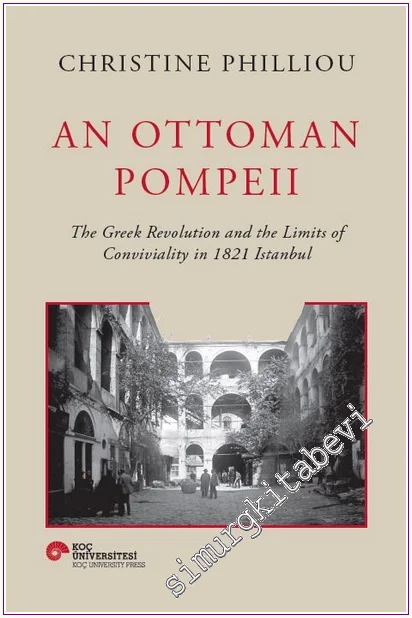
#smrgKİTABEVİ An Ottoman Pompeii CİLTLİ -
Editör:
Enis Köksaldı
Kondisyon:
Yeni
Sunuş / Önsöz / Sonsöz / Giriş:
Kapak Görseli:
İzmir Limanı Tahmil ve Tahliye İşçileri, 1954
Dizi Adı:
Osmanlı Tarihi
ISBN-10:
Hazırlayan:
Cilt:
Amerikan Cilt
Boyut:
16x24
Sayfa Sayısı:
424
Basım Yeri:
İstanbul
Baskı:
1
Basım Tarihi:
2026
Kapak Türü:
Ciltli
Kağıt Türü:
Enso Kâğıt
Dili:
İngilizce
Kategori:
indirimli
900,00
Havale/EFT ile:
882,00
DİKKAT! Ön Sipariş Ürünüdür. 13.10.2026 tarihinde dağıtıma verilecektir.
1199268491
656667
https://www.simurgkitabevi.com/an-ottoman-pompeii-ciltli
An Ottoman Pompeii CİLTLİ - #smrgKİTABEVİ
900
At the outbreak of what would become known as the Greek Revolution, and what Ottoman authorities confronted as a Greek insurgency, Istanbul became the stage for a crisis that would reshape the Ottoman Empire and the eastern Mediterranean. An Ottoman Pompeii: The Greek Revolution and the Limits of Conviviality in 1821 Istanbul uncovers this moment through an extraordinary population register compiled in spring and early summer 1821, just as rebellion, reprisal, suspicion, and imperial surveillance converged in the capital.Christine Philliou treats this register as a time capsule: a granular record of more than 13,000 non-Muslim residents—Orthodox Christians, Armenians, and Jews—whose world emerges above all through Istanbul's hans and their rooms, as well as through their neighborhoods, occupations, origins, and networks. Like Pompeii, preserved by catastrophe, the register freezes an urban world at the instant of rupture. It reveals not only the violence and fear surrounding the imperial response to revolt, but also the everyday coexistence, labor, migration, and social intimacy that still bound Istanbul's communities together. By including a verbatim transliteration of the register, An Ottoman Pompeii also opens this remarkable source to further research, enabling scholars to trace new patterns of urban life, labor, migration, coexistence, and rupture in the Ottoman capital.Moving between Ottoman imperial history and the emergence of Greek national history, An Ottoman Pompeii offers a new way of seeing the city before modern categories hardened: as a dense, fragile, and interconnected world whose traces were recorded at the very moment its foundations were beginning to fracture.Christine Philliou is Professor in the Department of History at University of California Berkeley and Director of the Modern Greek/Hellenic Studies and Turkish, Ottoman and Post-Ottoman Studies (TOPOS) programs there.Transliteration Editor: Elias KolovosData analysis and visualizations: Firuzan Melike Sümertaş
At the outbreak of what would become known as the Greek Revolution, and what Ottoman authorities confronted as a Greek insurgency, Istanbul became the stage for a crisis that would reshape the Ottoman Empire and the eastern Mediterranean. An Ottoman Pompeii: The Greek Revolution and the Limits of Conviviality in 1821 Istanbul uncovers this moment through an extraordinary population register compiled in spring and early summer 1821, just as rebellion, reprisal, suspicion, and imperial surveillance converged in the capital.Christine Philliou treats this register as a time capsule: a granular record of more than 13,000 non-Muslim residents—Orthodox Christians, Armenians, and Jews—whose world emerges above all through Istanbul's hans and their rooms, as well as through their neighborhoods, occupations, origins, and networks. Like Pompeii, preserved by catastrophe, the register freezes an urban world at the instant of rupture. It reveals not only the violence and fear surrounding the imperial response to revolt, but also the everyday coexistence, labor, migration, and social intimacy that still bound Istanbul's communities together. By including a verbatim transliteration of the register, An Ottoman Pompeii also opens this remarkable source to further research, enabling scholars to trace new patterns of urban life, labor, migration, coexistence, and rupture in the Ottoman capital.Moving between Ottoman imperial history and the emergence of Greek national history, An Ottoman Pompeii offers a new way of seeing the city before modern categories hardened: as a dense, fragile, and interconnected world whose traces were recorded at the very moment its foundations were beginning to fracture.Christine Philliou is Professor in the Department of History at University of California Berkeley and Director of the Modern Greek/Hellenic Studies and Turkish, Ottoman and Post-Ottoman Studies (TOPOS) programs there.Transliteration Editor: Elias KolovosData analysis and visualizations: Firuzan Melike Sümertaş
Yorum yaz
Bu kitabı henüz kimse eleştirmemiş.