Arama için en az 3 karakter girmelisiniz.

#smrgKİTABEVİ Signal to Decision : An Integrated Precision-Oncology Decision Board Manual - Clinical Genetics Molecular Pathology Oncology Logic Imaging Nuclear Medicine Pharmacogenomics Theranostics and Board-Level Decision Support -
Editör:
Kondisyon:
Yeni
Sunuş / Önsöz / Sonsöz / Giriş:
Basıldığı Matbaa:
Dizi Adı:
ISBN-10:
9786258793604
Hazırlayan:
Cilt:
Amerikan Cilt
Ciltçi:
Stok Kodu:
1199263962
Boyut:
21x28
Sayfa Sayısı:
346
Basım Yeri:
Konya
Baskı:
1
Basım Tarihi:
2026
Kapak Türü:
Karton Kapak
Kağıt Türü:
1. Hamur
Dili:
İngilizce
Kategori:
indirimli
715,50
Havale/EFT ile: 701,19
Siparişiniz 4&6 iş günü arasında kargoda
1199263962
651607
Signal to Decision : An Integrated Precision-Oncology Decision Board Manual - Clinical Genetics Molecular Pathology Oncology Logic Imaging Nuclear Medicine Pharmacogenomics Theranostics and Board-Level Decision Support -
Signal to Decision : An Integrated Precision-Oncology Decision Board Manual - Clinical Genetics Molecular Pathology Oncology Logic Imaging Nuclear Medicine Pharmacogenomics Theranostics and Board-Level Decision Support - #smrgKİTABEVİ
715.5
Precision oncology has never lacked data. What it lacks, too often, is a disciplined way to turn that data into a decision a clinician can defend, a patient can understand, and a board can stand behind. A sequencing report, a tracer-avid lesion, a drug label, a polygenic score - each is real, and each is dangerous when read alone. The variant without a pathology anchor, the avid lesion without dosimetry, the label without line-of-therapy context: these are not rare mistakes. They are the predictable result of starting from the test instead of from the question.

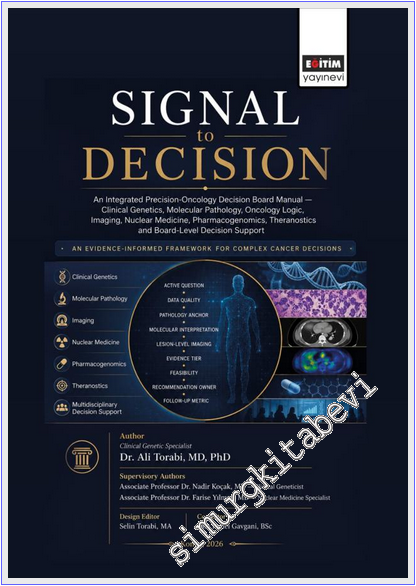
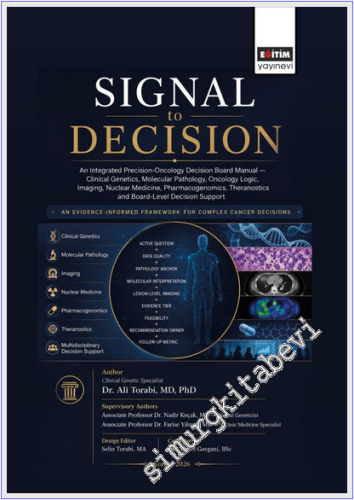
This book was written to invert that order. Its organizing claim is simple and, I hope,durable: a precision decision begins with a clinical question, not a result, and no recommendation is safe until pathology, molecular findings, imaging, nuclear medicine, germline status, pharmacogenomics, feasibility, and the patient's own goals have been integrated and weighed. Everything here - the layer-by-layer reasoning, the evidence tiers, the one-page board report, the standing safety rules - serves that single architecture: active question, data quality, pathology anchor, molecular interpretation, lesion-level imaging, evidence tier, feasibility, recommendation owner, follow-up metric.

Precision oncology has never lacked data. What it lacks, too often, is a disciplined way to turn that data into a decision a clinician can defend, a patient can understand, and a board can stand behind. A sequencing report, a tracer-avid lesion, a drug label, a polygenic score - each is real, and each is dangerous when read alone. The variant without a pathology anchor, the avid lesion without dosimetry, the label without line-of-therapy context: these are not rare mistakes. They are the predictable result of starting from the test instead of from the question.

This book was written to invert that order. Its organizing claim is simple and, I hope,durable: a precision decision begins with a clinical question, not a result, and no recommendation is safe until pathology, molecular findings, imaging, nuclear medicine, germline status, pharmacogenomics, feasibility, and the patient's own goals have been integrated and weighed. Everything here - the layer-by-layer reasoning, the evidence tiers, the one-page board report, the standing safety rules - serves that single architecture: active question, data quality, pathology anchor, molecular interpretation, lesion-level imaging, evidence tier, feasibility, recommendation owner, follow-up metric.

Yorum yaz
Bu kitabı henüz kimse eleştirmemiş.
Kapat